الصفحات

Showing posts with label Game Review. Show all posts

Friday, 30 September 2016

Seraph

Introduction

 Seraph was released on Steam as an early access title and today we’re going to be reviewing it.


What is Seraph? An action platformer with a clean cut focus on skill-based acrobatics and shooting is the best way to describe it. I will say from the get go that Seraph has no aiming elements: it automatically picks your target while you focus on dashing around and looking cool. Many have been skeptical of this approach, but the team ensures that the movement based elements of the game are complex enough not to make this a very simplistic title. It also has a sliding scale of difficulty that changes based on how well you’re performing. Neat idea and I’m hoping that its implementation is as solid as Dreadbit claims.
Anyway, let’s load up and frag out, shall we?

Prelude & Setup

Seraph is pretty chunky installation at 2.7 GB, but the download is just 363 MB – that’s some pretty stellar compression! While I waited for the download, I checked out the community page on Steam. The latest post was a development roadmap that basically outlined how Seraph is going to transition from early access through to full launch.
Future content planned for this game includes additional miracles (I imagine these are similar to ultimate abilities), blessings (passive bonuses that increase with each level), more boss attacks, daily challenge modes and localisation for more languages. Complete introduction of all game elements is due in about 3 months.

The Twitch features aren’t something that I can really utilize, but it does have a box available for your webcam so that if you plan to stream Seraph, you’ll have an easy time doing so. Additionally, streamers can also bring an element of viewer interaction with various buffs and debuffs made available via chat inputs. I should also point out that the controls for Seraph are more suited toward using a handheld controller. You can still play with a keyboard though!
Sadly, no windowed borderless is available and no quality options are provided. What I will say is the transitions on the menus is really smooth and as far as design goes, they’re quite pretty.

Gameplay

The game has five modes to pick from when you start: standard, hard, extreme, speedrun and Twitch mode. I picked standard mode to begin with and played through the tutorial. My first impressions of the game are positive at this point: it looks clean, the controls are easy to follow and the tutorial gives just the right amount of information to give you an idea of how the core elements of Seraph work. It takes about 10 minutes to complete, so run through and you’ll have no issues figuring out how to play.
You’ll eventually hit the first level of the game and have the chance to kick some ass. There’s a mixture of simple enemies, medium-level and of course, bosses to encounter. After each level, you’re presented with the following screen that displays a heap of information about how you performed.
Related:For Honor Review

Throughout levels, you’ll be opening up various environment elements that provide you with different drops. I actually found a new weapon in the first level, but it had a limited amount of ammo (unlike the starter pistols, which were unlimited). Some crates also provide you with health, so if you do make a snafu, getting back on track isn’t impossible.
The auto-aim feature is quite enjoyable. I played an MMORPG a few years back called TERA, which basically had its selling point as being skill-based, with a lot of benefits afforded to those that were capable of dodging enemy skills. I feel that this game has the same spirit: you’re rewarded for watching what’s going on around you and making sure that you position yourself accordingly to maximize damage and of course, survivability.
When you hit level 2 you’ll be able to select a blessing and you should have enough Shards available to unlock a few oaths. As far as I can tell, you can only get to the oath page by going back to the main menu: I think that this could be redesigned to be available between levels to make it easier for players to understand the progression of the game. For some, they might completely miss this aspect of Seraph, which would be a big mistake. Anyway, because I was getting chunked a little, I decided to put my first shard points into the defensive tab to help boost my HP. You should also check out the Transmutation tab while you’re at it. This is another type of currency you collect in the game to unlock the ability to craft things using drops from enemies in the levels you come across.

It’s actually quite hard to get screenshots of battle, simply because taking even a second to stand still and stop shooting to hit the print screen button is going to set you back. I soon started to appreciate just how important movement is in Seraph: getting hit is incredibly punishing. In a lot of shooting games, killing the enemies as soon as possible is the ultimate aim, but in Seraph, I elected to just take my time and make sure that I was avoiding death above all else. This means that you’ll be jumping around a lot and dashing through anything that looks like it’s about to send out a deadly attack.
The crafting system isn’t fully implemented yet, but I did upgrade a few weapons over the course of playing to make things a little easier. Contrary to my previous claim of not wanting to get killed, I did focus on the shotgun and had a blast getting as close as possible to some enemies and hitting them right in the face.
Every day, Seraph has a Challenge mode option where players enter a seeded level that basically has you surviving for as long as possible. There’s a high score table and rewards for those that finish well. I’m not too sure what those rewards are, but an educated guess would suggest crafting materials.

Other

The scaling difficulty in Seraph is a great feature. You’ll actually get better drops as you get deeper into the difficulty levels and it will work with you to ensure that the enemies are a suitable difficulty for your skill level. The game’s graphics are nice and the resource usage was quite reasonable given how pretty it looked. The music is good and as far as I can tell, it adjusts itself in terms of loudness and intensity based on your difficulty level and current position. It’s been done before, but the implementation here is solid.
I was racking my brain trying to think of what’s not so hot with Seraph, and the only real thing I can come up with is that this game features many elements that show it’s going to be a port. A PS4 version will be developed, and a lack of PC-based elements is a little disappointing. It’s not the end of the world by any stretch of the imagination, but still something to think about.
As I mentioned in the gameplay part of the review, I’d like to see better management of the upgrades and character development system. The tutorial is good, but it feels like it glosses over these elements of the game without really explaining them to you. Ideally, having the tutorial walking through the process of playing around with the upgrades menu would be groovy.

Conclusion

For an early access game, Seraph doesn’t feel too shabby. More skills would make the dynamics of playing the game a little more interesting, but this is a great starting place that I think the team is really going to improve on. I don’t actually play a lot of action platformer games, but Seraph was really enjoyable and did the whole auto-aim thing justice. I can already tell from how the PC version plays that those using controllers will have a whale of a time.
I’d also like to stress that the speedrun and challenge elements of Seraph, alongside its Twitch.tv integration, is what we need games in 2016 to feature. It’s great to see a company fiddle around with their game and bring a fresh breath of air to basic design principles. Gaming is a lot more than just one dude sitting in his mom’s basement now, and having that dweller be able to compete against others and stream is a step in the right direction for the gaming community.
Seraph is available for purchase now via Steam for a price of $12.99.

Sunday, 4 September 2016

For Honor


GamePlay :


Release Date: February 14, 2017 Platforms: PS4 (version tested), Xbox One, PC
Jason Vandenberghe became my spirit animal at E3 2016. Stood centre stage at Ubisoft’s press conference, For Honor’s creative director delivered a passionate speech on par with Leonidas in 300. He roused the audience about a project clearly very close to his heart. Getting a chance to play the game, while a little rough around the edges, it still manage to get me excited for a genre that’s all-too rare on current-gen.
For Honor’s trailer portrays the futility of war. Three factions furiously fighting for so long that the original reason for their conflict is lost to the ages. Now, we get to join the battle between the Vikings, Samurai and Knights, the campaign letting us play as a chosen hero from each of the three.

For the first mission we join the Knights, who must defend the castle from an attempted invasion of the Blackstone Legion – their role in this battle is a little unclear, but it seems their intention is to ensure this conflict rages on for eternity.


I’m immediately struck by how gorgeous For Honor is. The wonderfully vivid lighting, the detail on the Knights’ armour, the flame effects as arrows rain down from archers onto the troops’ castle. It all looks incredible, and it’s a joy to run around this fort and take in the detail.
What is a little less polished, however, is the dialogue. Granted, this is a world where men are men who drink beer and kill for a living (you can play as women, too, but from my experience in the game the enemies you face are exclusively male), but the voice-acting is so on-the-nose that it becomes comical at times. Think a 1970s dubbed martial arts movie and you’re probably somewhere close.

Related: Mafia 3 Review


Finally heading into battle we’re introduced to the controls, and there’s an interesting rock, paper, scissors mechanic in play. You must hold L2 to lock onto an enemy, pressing it again will change which unfortunate foe is next for the sword, then you must hold your sword in one of three stances, using the right stick. Matching the stance of your opponent means you can block their incoming strikes, then respond in kind by striking from a different stance with light or heavy attacks.
When facing a tough opponent, it can create decent encounters that require patience and good timing, although it can be a little fiddly switching from right stick to face buttons (X is dodge, Square is guard break) in order to become an effective swordsman.


However, the mechanic can run into trouble when the numbers aren’t in your favour. Because you’re forced to lock on in order to engage in combat, dealing with multiple enemies at once can be a bit fiddly. You have to release and press lock-on each time you want to switch target, and the combat mechanics are purely for dealing with one foe. There are no sweeping or area-of-effect strikes like in Dynasty Warriors, you’re only bet is to dodge roll your way out of trouble and try and keep all enemies in front of you, limiting the chances of being flanked.
However, there are opportunities to take on large groups of enemies and do serious damage, as there will be instances when you face much weaker opponents that can be killed with one hit, just to create that sense of all-out war. These moments are great in fleeting spurts, but can become tedious if they outstay their welcome. From the demo I played they’re used wisely, with these one-hit weaklings peppered amongst tougher enemies just to keep things interesting.
Eventually we defend the castle, and then must take on a boss: the Blackstone Legion leader’s elected champion. This is where the mechanics shine: when the battle is tough. Balancing stamina, keeping an eye on your enemy’s stance and knowing when to dodge and guard break can be thoroughly entertaining. I wish there was a way to turn off the HUD so I there are no arrows telling me my foe’s stance, and I must deduce it only through body posture. The dev tells me at present this isn’t a feature that can be turned off; I hope this changes before the Valentine’s Day launch.
We then switch to playing the E3 presentation demo as the Vikings against the Samurai, and this is a much greater challenge and also far more entertaining, mainly because the Vikings are a much more fun class. Slower to attack but dealing much greater damage, the Viking hero can also pick up and carry enemies great distances on his shoulder, meaning you can throw them off ledges or launch them onto spikes. I pull off both moves seen in the E3 trailer and it’s immensely satisfying.


My time with the demo culminated in a 4-versus-1 match against my favour, a giant Samurai leader capable of dealing immense damage. If that wasn’t enough, I also had to deal with and his cronies.
I’m fighting desperately, hammering lock-on to make sure I attack the most immediate threat and it’s here where the system struggles. Because movement lacks the intricacy of a Bayonetta or Devil May Cry, it feels like I lack the control to manipulate my character within combat.
Sometimes I was acting out of desperation rather than calculation. Frantically fleeing for space, unable to attack the crowd of enemies simply because locking onto one opponent meant I was vulnerable to the other three.
I wish there was a more organic system, just to make the battles have a little greater sense of flow to them.

FIRST IMPRESSIONS

Overall, the combat has the potential to be great, and I did have fun in spite of these shortcomings. This is a meaty brawler. It is the closest we’ve come to a payable 300 game, and that makes me interested to see more from For Honor.
Plus, with a man as fiery as Vandenberghe at the helm, I’ll definitely be following this title with a keen interest. If he is able to translate even half of his passion and energy into For Honor, I’m on board.


Monday, 29 August 2016

Mafia 3

Release date: 7 October
22 mins of Gameplay  
Platforms: Windows, MacOS, PS4 and Xbox One.
Violence has always been an integral part of The Mafia series, but based on the new gameplay footage shown behind closed doors at E3, the third entry in the series takes it to a new, perhaps unnecessary, level.
At the presentation we were shown a huge amount of Mafia 3 content. First was a map of the world – New Bordeaux – which is based on New Orleans. The game is set in 1968, a big year in the US in terms of civil rights and race relations.
There are a number of districts to explore, including the Bayou, a “mysterious” forested area ripe for exploration; Frisco Fields, a wealthy part complete with mansions and parks; and the French Ward, the neon-filled party district where every vice you can think of – and a few more besides – can be found.

The city looks fantastic, with atmospheric lighting, dirty streets and colourful neon lights adding to a feeling of the place being alive. The graphics look great.
From this point onwards, my preview contains minor plot spoilers.
The story of the game follows Lincoln Clay, a Vietnam veteran who’s come back from war and has joined the Black Mafia. Betrayed by the Mob, who all but wiped out the Black Mafia, Clay is now on a path of uncompromising revenge and is looking to take the city of New Bordeaux into his own hands, one district at a time.

Joining him for the ride are three cronies who all have a beef with the Mob: Cassandra, Burke and Scaletta. These characters are central to the game’s management layer, in which you take hold of city districts and assign management of them to one of the three. Your choice affects your abilities and the bonuses you receive in those districts, so your decision does have some consequences.
In the gameplay we were shown, the player had been ignoring Burke, failing to assign him much territory of late. When Clay doesn’t offer Burke his latest capture district, we see him angrily storm out, threatening to kill our (anti) hero.
If one of your cronies gets cheesed off to that level, you’ll be handed a mission in which you have to wipe them out. As a result, not all players will experience the same missions; it will depend entirely on the decisions they take at management level.

The conversations experienced at the territory discussion meeting appear rather forced. The characters' responses are based on the current situation, and as a result are fairly generic. They don’t add anything to the overall experience, and in fact make the three cronies appear like they’re not actually central characters at all.
Away from the management side of things, we were also shown a big chunk of mission gameplay. There will be central story missions, of course, but there are also optional quests that you complete, whereby you gradually bring down district leaders by depleting their stash of cash. These take the form of robberies, shooting up orgies, interrogating people and you generally being an all round nuisance.
You get to choose which of these side missions you fancy, and before each one you're presented with the option of calling in your friendly local arms dealer to pick your loadout. If you find that things are going south, you can call in reinforcements, who appear almost instantly and unleash Tommy gun hell on everyone who stands in their way.

The combat is fairly standard over-the-shoulder fare, but there are a couple of points of interest. The first is a witness counter, which shows you how many people will see the crime you’re about the commit. The second is Clay’s magical – and so far unexplained – ability to see through walls to highlight enemies; was this a skill upgrade through some sort of RPG-style tree, or will this be available from the start? We’ll have to wait and see.
We were also shown an entire story mission. Clay is hell-bent on killing a local rich businessman, and finds himself the perfect opportunity when said mogul organises a lavish party on a paddle steamer. You can see where this is going.
It’s here where Clay’s motivations become rather more troublesome. We were shown Clay blowing up a gantry over the boat, causing the vessel to collapse and half-sink. In what are actually quite disturbing scenes, many party-goers are set alight and others fall into the river and are snapped up by alligators. That’s a lot of innocent civilian murder just to kill one man, and I think I’d struggle to play through this mission without feeling a little disenfranchised with Clay’s behaviour.

We’re not given an explanation of who exactly the party-goers are; so many of them could be what we now consider to be on the wrong side of history, but it’s still hard to put yourself in Clay’s shoes at that moment.
From there, you find the businessman, kill him and hang him from a statue in the middle of the city, which is another fairly extreme action.

I'm no hypocrite; I'm more than aware that I revelled in going on destructive sprees with Trevor in GTA V. But there I had a choice, and GTA's light-heartedness made it feel okay. Here, it's serious, and you have no choice but to murder as many people on that steamboat as possible. It just doesn't sit right with me.

FIRST IMPRESSIONS

I’ll take into account that we don’t yet know Clay’s full story – after all, there have been plenty of excellent mafia films where the antihero performs unsavoury acts. The dude’s had an extremely tough life and has absolutely nobody to care for, so for that character this behaviour probably makes sense.
The problem is, playing such an antihero might prove a turn-off for many. I’ll reserve full judgement for when the game is actually released.

Monday, 22 August 2016

Far Cry 4

Available on PS4 (tested), Xbox One and PC
Ubisoft has definitely got a theme this year and it’s one of choice. Assassin’s Creed Unity introduced open-world assassination missions so you can choose how to approach your target, while Watch Dogs put a tonne of hacking gadgets at your disposal and let you decide which ones to use. Then there’s the huge open world racer The Crew due out in early December.
That theme of choice pervades Far Cry 4, too, which is apt given the series has always had a strong sense of exploration, freedom and choice. But Far Cry 4 takes this freedom to another level within the storyline itself.
Far Cry 4 sees you play as Ajay Ghale, a young man returning to his homeland of Kyrat with one mission – to scatter his recently deceased mother’s ashes. As you’ll know from the various trailers though, Ajay’s arrival into Kyrat doesn’t go quite as planned thanks to the country’s tyrannical King, Pagan Min.


Of course, the main aim throughout the game is to get back to Pagan Min, who sadly features very little throughout the game despite him being one of the strongest characters.
Instead, you’ll find yourself caught between Amita and Sabal, the two leaders of the rebellion, The Golden Path. Here’s where the choice part comes in. At key points during the campaign, you’ll have to decide whether to side with Amita, who tends to be the more modern of the two, or Sabal, who is more concerned with the history and traditions of Kyrat.
The choice you make affect the immediate missions. For example, one choice might mean deciding between gathering intel from Pagan’s men for Amita or protecting some of your soldiers in one of Kyrat’s villages for Sabal. However, it initially feels like your choices only affect that one mission. Once you’ve chosen one side or the other, the next Golden Path mission will be the other leader giving you the guilt trip and then it’s over.
But as you continue through the campaign, you start to see that your decisions have slightly larger consequences. Don’t expect storyline ripples a la Mass Effect, but at the end, the finale plays out the way it does because of the decisions you’ve made in the closing missions.

Although the main Golden Path missions will mainly see you completing tasks for Amita, Sabal or another lady called Noore, you will meet some other characters during your Far Cry 4 story.
One of those will be a familiar face for those of you who played Far Cry 3 – Willis. The undercover CIA agent makes a return in Far Cry 4 to give Ajay some information about his family and he has the majority of the mountaintop Himalayan missions to gift you.
There’s also Longinus, who is a religious nut trying to atone for his sins by collecting blood diamonds from Pagan’s men. He definitely means well, but his extended spouting of bible literature makes you wish Far Cry 4 had skippable cutscenes. Thankfully, he only crops up in four missions, but we advise popping to get a cup of tea while he harps on.
You’ve also got Hurk missions. Hurk is the guy your pal will play as in the co-op sections, but you can also do some missions for him within the single-player campaign. He has a bizarre sense of humour and a rather irritating voice, but his missions are extremely fun – especially when you get to go mad with a pneumatic stake.
Often The Golden Path missions aren’t available for a time. This forces you to pick up some of the side missions. That is particularly true for the Yogi and Reggie side quests that see you embark on some drug-fuelled adventure that will have Kyrat radiating in psycadelic colours before your eyes as statues drop from the sky or enemies spontaneously combust. They’re very trippy and have the best soundtrack, so are worth a laugh or two.

But even if you don’t fancy picking up a mission at any particular point, there’s always tonnes to do in Far Cry 4. Like all the series previous entries, there are animals to be hunted, gear to craft and enemy outposts to commandeer among plenty of other tasks.
Mimicking Far Cry 3’s crafting system, you’ll need to collect the pelts of Kyrat’s thriving animal population in order to create better items, including weapon holsters, loot bags, ammo pounches and other incredibly useful items.
A useful tip is that if you take down an animal using a bow and arrow or throwing knife, you’ll be rewarded with a “clean kill” alert, offering you two pelts rather than just one and some karma points to boot. With every kill you’ll also grab a little of the animal’s meat as bait, which can be used to force the wildlife to help in your battles, or as a distraction for a larger animal so you can take them down for their skins.
Kyrat is home to a vast array of animals, such as Malayan tapirs, Bengal tigers, bears, rhinos, snow leopards and of course, honey badgers – the devilishly fast, extremely hard to kill but also rather cute looking little beasts. Eagles are surprisingly evil, too. You’ll hear them screech overhead while on one of your many strolls and suddenly one will attack from above. We also saw them kill off a Bharal or two and lift them off into the sky.
Elephants are our favourite addition to the Far Cry series and don’t even think about trying to kill one (in single-player anyway). Once you’ve unlocked the skill, you can ride them and turn them into a powerful weapon. You can ride them to charge at enemies, toppling their vehicles or lifting them up by their legs and smashing them into the ground.

Skills themselves are split into two different categories, rather than Far Cry 3’s three distinct skill trees. In Far Cry 4 you have the Tiger Skills for attacks, or the Elephant Skills for increased health, more effective syringes and the ability to ride elephants. Skill points are earned by collecting XP throughout the game, which you’ll get for taking down enemies, animals and pretty much doing anything in Far Cry 4.
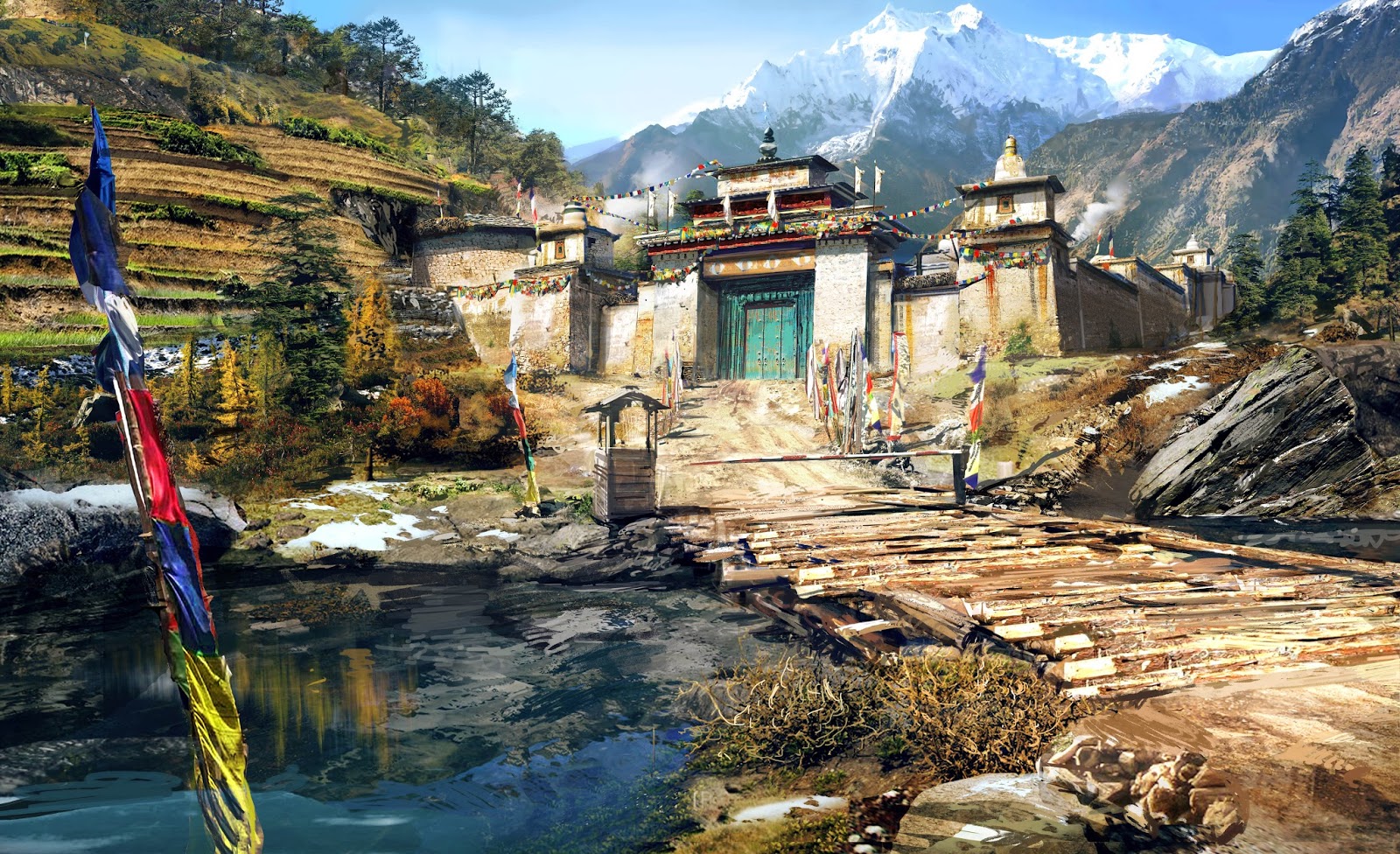
But there will be times you want to do nothing but explore Kyrat. The India/Tibet inspired landscape looks magnificent, with the Himalayan mountains surrounding you on most sides of the map, their daunting peaks piercing the sky. The south side of Kyrat is lush with greenery and is where you’ll find the majority of the country’s wildlife. The north is far more barren, with snowflakes occasionally floating through the air. You’ll notice that buildings are made from stone rather than wood the more north you go, highlighting that wood is a more abundant material in the south, while the northerners have a lot more stone at their disposal.
We spent a very long time just driving around appreciating the detail that Ubisoft has put into crafting Kyrat and its unique mythologies, history and customs. Part of that is experienced through the Shangri La missions, which are accessed by collecting the scattered parts of a torn up tapestry that have been flung to the four corners of the map.
These missions see you take on the role of one of Ajay’s ancestors, in a world where the rivers run red and demons are trying to take over. You have a rather powerful white tiger as your ally and, armed with a time-manipulating bow, you’re trying to rid Shangri La of the demons and free the spirit bells.
Shangri La is not pushed upon you, as we originally anticipated, but are rather offered as a way of experiencing the back story of Kyrat. Even if you only do one or two of the missions, it’s an interesting way to learn more about the fictional country.

If Assassin’s Creed Unity is the best cityscape we’ve experienced on PS4 and Xbox One, then Far Cry 4 is easily the most impressive landscape currently available. Just jump in a tuktuk or another vehicle or take to the skies in a Buzzer (or gyrocopter) and allow yourself some time to really see Kyrat and its wildlife.
Kyrat is simply stunning. The animals are the most realistic we’ve seen, to the point that you feel really guilty for killing any of the endangered ones like the Bengal tiger or the Asian rhinos.
It’s the soundscape that also makes this one of the most immersive open world games to date. Not only will you hear eagles overhead, pigs squealing in the villages, bears growling from the dense pines or the roar of an approaching big cat, but Far Cry 4 will fill your ears with the noises of the Indian inspired world. Garlands of bells jingle in the wind; the clunks of the travelling Sherpa trade store can be heard from a good distance; and if you start exploring the game’s atmospheric music starts to kick in. Sometimes you’ll want to just stand and listen it’s that good.
Or you’ll just find yourself searching out the myriad collectibles lurking across the Kyrat map. There’s the normal chests to seek out as well as demon masks, points of interest and there are outposts to be liberated too. Each of those opens up a selection of green mission markers, which come in the form of hunting, escort or other shorter missions to earn you XP and lots of new skills.
Thanks to the new ability to shoot sidearms while driving, there are also some mini-missions to pick up on the road, like taking out couriers or royal trucks. It’s a skill that we’ve long needed in Far Cry games and is invaluable in Kyrat – a world where it can feel like everyone is out to get you.

Of course, it does help that you can bring in a pal for a bit of co-op every now and then if you want to. You can invite any of your friends to play co-op by holding down on the directional pad, or you can join their game by choosing the "offer help" option.
You’ll need to tackle some of the harder fortresses with a friend anyway, as they’re near impossible on your own unless you’re extremely stealthy and ridiculously patient.
We had a lot of fun just doing what Pagan Min suggests at the beginning of the game – blowing some stuff up. We grabbed a pal, hopped in a gyrocopter and took out an outpost in minutes with a pair of RPG sidearms, catapulting grenades directly into our foes below.
The co-op helps make Kyrat a bit more your own, as you build stories of the experiences you’ve had with friends. You’ll experience some of that on your own of course, especially with the temperamental wildlife, but co-op adds another layer of unpredictability.

Ubisoft has also introduced a new PvP multiplayer mode called Battles of Kyrat. It’s a round-based multiplayer format that sees you play as either team – the Rakshasha or the Golden Path.
As in the single-player campaign, the Golden Path has gadgets, weapons and vehicles at its disposal. You can kit yourself out with armour or weapon upgrades at the base before you head out, and you can use the radio towers to highlight enemy Rakshasa players on your mini-map. You’re basically playing as a team of Ajays with the Golden Path.
The Rakshasa, on the other hand, are at one with nature. You’re armed with a bow and arrow and a knife, but the animals are your real weapons. Build up a mini kill streak and you’ll unlock the ability to first unlock an eagle to fight for you, and later a bear and a tiger. You can also ride the elephants as you can in the main missions, which are a formidable force in small bases.
There are three different multiplayer modes at the moment. Demon Mask is the Far Cry 4 take on Capture the Flag, where your team must go and collect the Demon Mask from a roaming location and deliver it back to one of two shrines without getting taken out.
Outpost sees the Golden Path try to defend a base, while the Rakshasa must try and take it for themselves. They’ll need to stay in the flag area for the requisite amount of time for the base to be successfully captured.
Finally, there’s Propaganda – our favourite. There are three locations (A, B & C) dotted around the map, which the Rakshasa must try to protect. The Golden Path’s aim is to plant bombs and successfully detonate them before the Rakshasa can disarm them.
It’s all a bit fast and furious in Propaganda as it requires strong teamwork to outmanoeuvre the other team.
In all three modes you’ll need to adapt your play style to the team you’re currently fighting as. There’s no point trying to go in all guns blazing if you’re the Rakshasa. It’s all about using the environment. You can even turn invisible if you stay crouched and move slowly. The Golden Path will only hear the whisperings in the wind to know that you’re somewhere close, allowing you to take them out… if you’re quick with the bow.

For everything that’s wonderful about Far Cry 4, the game isn’t without its flaws. It feels like Ubisoft has in some ways produced a half baked pudding of a storyline. There’s a hint of player choice and consequence, which is constantly referred to by the characters, but it never really feels that you’ve made a choice that will affect the grand timeline.
The wildlife can also seem unnecessarily aggressive too. It’s fair enough that a rhino catching sight of you might charge at random, but eagles swooping from the sky unprovoked is unrealistic and frankly frustrating at times.
There’s also the fact that Ubisoft has chosen to unnecessarily hide some of the features of Far Cry 4 away, leaving you to figure out some crucial things for yourself. For example, your loot bag is now tucked away inside the Collection tab of the main menu, under loot bag. It’s not easy to find and at no point are you directed towards it. Thus, in the early stages of the game, you might find that tiger you need but your loot bag is too full and you’ve not found the way to chuck useless things away without selling them at trade points.
You also can’t craft health syringes yourself. Instead, Ajay will automatically create one for every two green leaves you harvest. Once you’ve figured that out, it’s a handy trick, especially mid-battle, but you’ll only ever see it explained in loading screen tips if you happen to die, which you will – a lot.
There were also issues with the sound at some points later in the game, where the voice and mouth movements would be out of sync – an irritating bug that really takes you out of the moment.
Verdict
You’ll struggle to find a game available now that looks or feels as immersive or as beautiful as Far Cry 4. And it’s only games like Assassin’s Creed Unity or Elder Scrolls V: Skyrim that can match it in terms of breadth of gameplay. It just feels like the story lets it down in places. Make choices count and give the player real power. Don’t just dangle the carrot.

Monday, 15 August 2016

Deus Ex: Mankind Divided


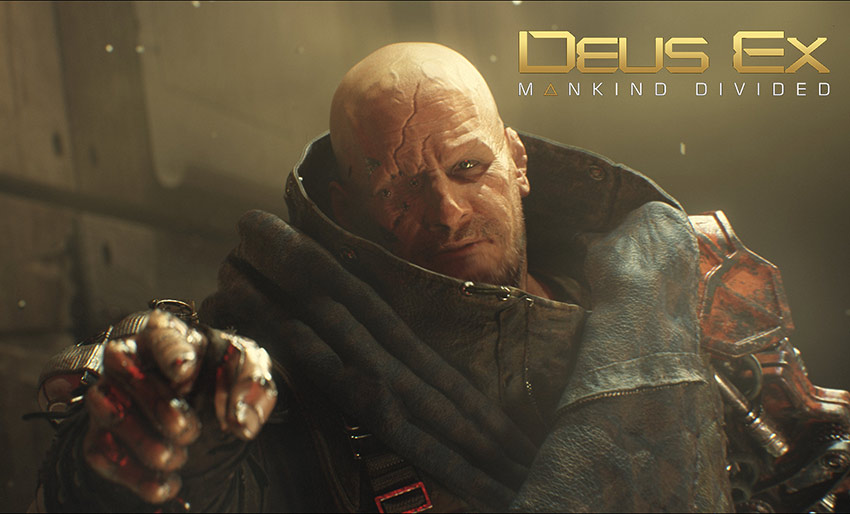
Acting as the sequel to 2011's critically acclaimed Deus Ex: Human Revolution, Mankind Divided once again has you playing as Adam Jensen in a dark, futuristic cyberpunk world. However, things have changed, with man and machine stuck in a bitter feud following a mechanical apartheid on a global scale. As you travel across the world in search of answers you can shoot, sneak and hack your way through a range of deadly scenarios. The possibilities open to you are positiviely staggering, and arguably more ambitious than ever before. We've gathered all the information you might need on Deus Ex: Mankind Divided ahead of its release later this month. DEUS EX: MANKIND DIVIDED PREVIEW IMPRESSIONS “For many gamers, Mankind Divided will be one of their most-anticipated games of the year and having played the first act, I can vouch for the fact that it’s simply unmissable.” – Brett Phipps, games editor,  DEUS EX: MANKIND DIVIDED RELEASE DATE: WHEN IS IT COMING OUT? Originally scheduled to arrive in February 2016, Adam Jensen's next espionage adventure was delayed last November by Square Enix. The game will now arrive on August 23 on PS4, Xbox One and PC. Related: Everything we know about Mass Effect Andromeda Eidos Montreal boss David Anfossi said at the time of the announcement that the delay was to ensure the game was a worthy successor to the criticially-acclaimed Human Revolution.


"I know that expectations are extremely high, and we not only want to meet those expectations, but exceed them," explained Anfossi. "We're confident and proud of the game so far. However, as we are now playing through the game in full we can see that it will require more time in post-production for tuning, iterations and refinement to meet our high standards.”
He continues, "We are sorry to disappoint you with this news, and also thank you for all of your support and comments. This game is a huge part of our lives and we don't want to compromise on its quality. So please be patient with us a little longer, and thanks as always for your passion and support – through thick and thin."
"It's a huge responsibility to work on Deus Ex Mankind Divided – we know, but also a huge privilege. We're determined to deliver the best game we can."

DEUS EX: MANKIND DIVIDED TRAILERS

The latest trailer for Deux Ex: Mankind Divided is a long one, showing off 6 minutes of gorgeous new gameplay. Narrated by protagonist Adam Jenson, the lengthy trailer presents a number of different playstyles found in the game:


The Adam Jenson 2.0 trailer displays some of our protagonist's new abilities and skills. It also gives us a small, dark glimpse of the world in Mankind Divided:


E3 2016 saw a flurry of new trailers drop for Mankind Divided, including a selection of lengthy gameplay demos. Courtesy of IGN Live, the following demo features 27 minutes of non-lethal gameplay:


DEUS EX: MANKIND DIVIDED STORY

The game takes place two years after the events of Human Revolution, in 2029. After the events of the Aug Incident, mechanically-augmented people have become outcasts, living in the ‘mechanical Apartheid’ era. Adam Jensen joins an Interpol task force to capture a terrorist group of augmented humans.


However, Jensen is actually working as a double agent, also working as part of a hacker group called the ‘Juggernaut Collective’. Jensen joined this group to collaborate to bring down the Illuminati he discovered during the last game.

DEUS EX: HUMAN REVOLUTION SAVE FILES IN MANKIND DIVIDED

Eidos Montreal has confirmed that there are no plans to allow players to import their save files from Human Revolution into Mankind Divided. Instead, the developer has taken decisions from different branching paths and incorporated them into the narrative of the sequel.


Players who completed Human Revolution will know that (*spoilers*) you had a choice over which message to broadcast at the very end of the game. Well, Eidos has said no matter which message you played, in the years since, the message was distorted in the collapse of Panchaea and what truly happened in the Aug Incident is lost. The swarming rumours and disinformation following the incident is what leads to the situation Jensen finds himself in in 2029.
We may find ourselves taking part in conversations that piece together the events of Human Revolution. This will help us form a solid context for the events in Mankind Divided, and how Adam Jenson's previous actions had monumentable consequences on the world he inhabits. The conclusion to Human Revolution received a lukewarm reception, but we've love to see its narrative play a part in this new adventure.

DEUS EX: MANKIND DIVIDED GAMEPLAY

Gameplay-wise, Mankind Divided will hand players much of the same freedoms, allowing you to tackle scenarios with a blend of stealth, action hacking and social interactions.


Deus Ex combines first- and third-person shooter elements, along with RPG upgrade systems and dialogue trees to give the player even greater choice in the outcome of scenarios. One of the great things about Human Revolution was the sheer variety of how every situation could be tackled, and this has been evolved with new weaponry, takedowns and more in Mankind Divided.
The way in which you tackle combat encounters and narrative sequences will have a genuine impact on the world you inhabit. Your actions will not only shape the game's story, but how your character is perceived by those around you.
Jensen has new augmentations, weapons and tools. Once again, you can complete the entire game without killing anyone.


DEUS EX: MANKIND DIVIDED PC SYSTEM REQUIREMENTS

Mankind Divided is just around the corner, and if you're playing on PC, you can start pre-loading from August 19 at 9am PT/12pm ET/5pm UK.
But first, you'll need to know what specs will be required to run the game, and if your gaming rig is up to the task. We've compiled the minimum and recommended specs below to make things easier.
Minimum
  • OS: Windows 7.1SP1 or above (64-bit Operating System Required)
  • CPU: Intel Core i3-2100 or AMD equivalent
  • RAM: 8 GB
  • Graphics: AMD Radeon HD 7870 (2GB) or NVIDIA GeForce GTX 660 (2GB)
  • HDD/SSD: 45 GB
Recommended
  • OS: Windows 10 64-bit
  • CPU: Intel Core i7-3770K or AMD FX 8350 Wraith
  • RAM: 16 GB
  • Graphics: AMD Radeon RX 480 – 1920 x 1080 or NVIDIA GTX 970 – 1920 x 1080
  • HDD/SSD: 55GB (Including DLC)
Did you ever ask for Deus Ex: Mankind Divided? Let us know in the comments.

Wednesday, 10 August 2016

Quantum Break

Few games use live-action cutscenes as emphatically as Quantum Break. It's one of the game's defining elements. Between each of its five gameplay-based chapters, you have the opportunity to watch roughly 20-minute-long episodes, which are entirely optional but designed to offer insight into the antagonist's state of mind. The rest of the pitch is that--by making narrative decisions between chapters--you can influence the story, which involves time-travel, an evil corporation, and a bit of brotherly love.
There's no getting around it: blending a "TV show" and a game in one package is a risky move, and unfortunately, one that doesn't pay off here. Both aspects of Quantum Break offer things worth getting excited about: combat is often explosive and chaotic in just the right way, and the show does a decent job of establishing intrigue that fuels your investment in the story. But the disparate parts don't gel well together because your influence over some events creates expectations that fail to pan out in the bigger picture. Your choices can have an effect on facets of the show and game--characters interact in different ways, and some minor events play out differently--but by and large, this isn't your story to mold. Quantum Break isn't the sort of experience that warrants a second playthrough, even though it confidently insists that it is.

Jack Joyce, the time-bending lead character played by Shawn Ashmore (Fringe, X-Men), is one of a few characters played by well-known actors, and for the most part, each member's professional acting chops are put to good use. Lance Reddick (The Wire, John Wick) delivers a great performance as Martin Hatch, whose motivations are open to interpretation right up until the very end. There are a number of other, lesser-known actors who deliver great performances as well, which goes a long way to distract you from the show's shortcomings. From the goofy henchmen costumes with massive insignias to the repeated use of the same prop cars during a chase--from shot to shot--there are obvious flaws to contend with.
Of course, Quantum Break is intended to be played rather than merely watched, but even if you skip its optional episodes, the best aspects of its gameplay are suppressed by frequent bouts of mundanity. Combat is the unequivocal star of the show here. At the start of the game, you're imbued with the ability to manipulate time, which allows you to slow down combat, speed up Jack's movement, create shields that freeze bullets upon impact, or cast Time Blast bombs near unsuspecting enemies. It doesn't take long to develop a flow, to understand how to link one ability to the next by managing each move's cooldown timer. You can thrust yourself into danger to establish line of sight on an enemy and protect yourself with a shield while you open fire. When your defense runs out, you can quickly zip into cover and cast a Time Blast or resort to your firearms while your abilities refresh.

There's no one right way to fight, and there's great enjoyment in experimenting with your abilities, not to mention witnessing the environment react to your powers as the scene shifts, cracks, and glitches out around you. Quantum Break is a great-looking game with some truly impressive character models that bring its actors to life, and the time-based special effects are a constant source of amazement. There's also an incredible amount of real-time destruction on display, which not only looks great but also keeps you moving during combat as enemies regularly destroy your hiding spots.
Quantum Break's basic shooting mechanics, however, are less impressive. You frequently rely on a dynamic-cover system; walk up to an object and Jack will automatically duck behind it. While it's possible to blind fire your Time Blast ability from cover, you can't use your guns with the same amount of freedom; you don't have the option to shoot while crouched. Instead, you're forced to stand up and expose yourself to enemies, and usually, take damage. While it's true that gunplay isn't the star of the show in Quantum Break, it deserves better treatment than it's received. There are times when enemies deploy devices that disrupt your powers, leaving you no choice but to defend yourself the old fashioned way. If you're flanked while in cover during these moments, prepare to get hit from multiple angles when you reach for your gun.
While it's true that gunplay isn't the star of the show in Quantum Break, it deserves better treatment than it's received.
When you aren't engaged in combat, you're usually exploring environments that offer narrative clues like documents and emails. These offer a wealth of supplementary information, sometimes pertaining to characters who only get screen time during the show. As a resource, they're valuable, but they are so dense that pausing to read every one in order to understand semi-interesting side stories is a tiresome effort to undertake.
Strutting between action sequences can be a welcome break, but not when you're funneled into woefully ill-conceived platforming challenges. In these sections, you have to awkwardly scale objects and leap around while fighting Jack's sloppy movement every step of the way. Your path in these moments is so tightly controlled that Jack doesn't even attempt to climb objects that he's not "supposed" to; he clumsily stumbles against them instead. During some of these moments, you need to use your time powers to arrange the scene in a way that allows you to get from point A to point B. The catch: your alterations only last for a short period of time, forcing you to wrestle with floaty movement under pressure.

Sadly, Quantum Break's gameplay is essentially divided equally between combat and hapless environment traversal. Given that the entire campaign can be completed in less than 10 hours--live-action episodes included--the distribution of activities feels that much more disappointing. Even if you go back and change your decisions--such as preventing a character from dying--your path essentially remains the same, albeit with a few minor elements remixed to hint at your agency over its plot.
By the end, you know the most important parts of the story. Replaying it to witness slightly altered events in the middle would require you to retread well-worn, sometimes boring territory for little payoff. Getting to the end of Quantum Break can be an interesting ride at times, but no matter how impressive the combat is, or how great the game looks, there's no getting around the fact that it's driven by a story with limited appeal and hindered by disappointing design decisions.